

Sports betting has come a long way from simply picking a winner. Remember when you had to choose between backing a team to win or placing an accumulator across multiple matches? Those days feel almost quaint now. The betting landscape shifted dramatically when bookmakers introduced bet builders—or "build bet" as many punters call them—and frankly, it changed everything.
This isn't just another betting option gathering dust in the corner of a sportsbook's menu. Build bet has become the go-to choice for millions of bettors who want more control, better engagement, and the ability to craft wagers that actually reflect their understanding of a match. If you've ever watched a football game and thought "I reckon there'll be loads of corners, City will dominate possession, and Haaland's bound to get a shot on target," then you've already got the mindset for building bets.
Here's what we're diving into: the mechanics of how bet builders actually work, the critical differences from other bet types, step-by-step placement guidance, winning strategies that professionals use, platform comparisons so you're not leaving money on the table, and the common pitfalls that separate smart bettors from those who consistently donate to bookmakers. This isn't theory. It's practical knowledge you can use tonight if there's a match on.
What Is a Build Bet (Bet Builder)?
Let's strip away the marketing fluff and get to what build bet actually means. At its core, a bet builder allows you to combine multiple selections from a single sporting event into one wager. That's it. No smoke, no mirrors. You're picking different outcomes from the same match and rolling them into a personalized bet that either wins as a whole or loses completely.
Think about a typical Premier League fixture. Normally, you'd have to place separate bets if you wanted to back Arsenal to win, over 2.5 goals in the match, and Bukayo Saka to have two or more shots on target. Three different bet slips, three different stakes, three separate results to track. Build bet consolidates all of that into a single wager. You make your selections, the bookmaker calculates combined odds that account for how these outcomes might influence each other, and you've got one bet to follow instead of juggling multiple tickets.
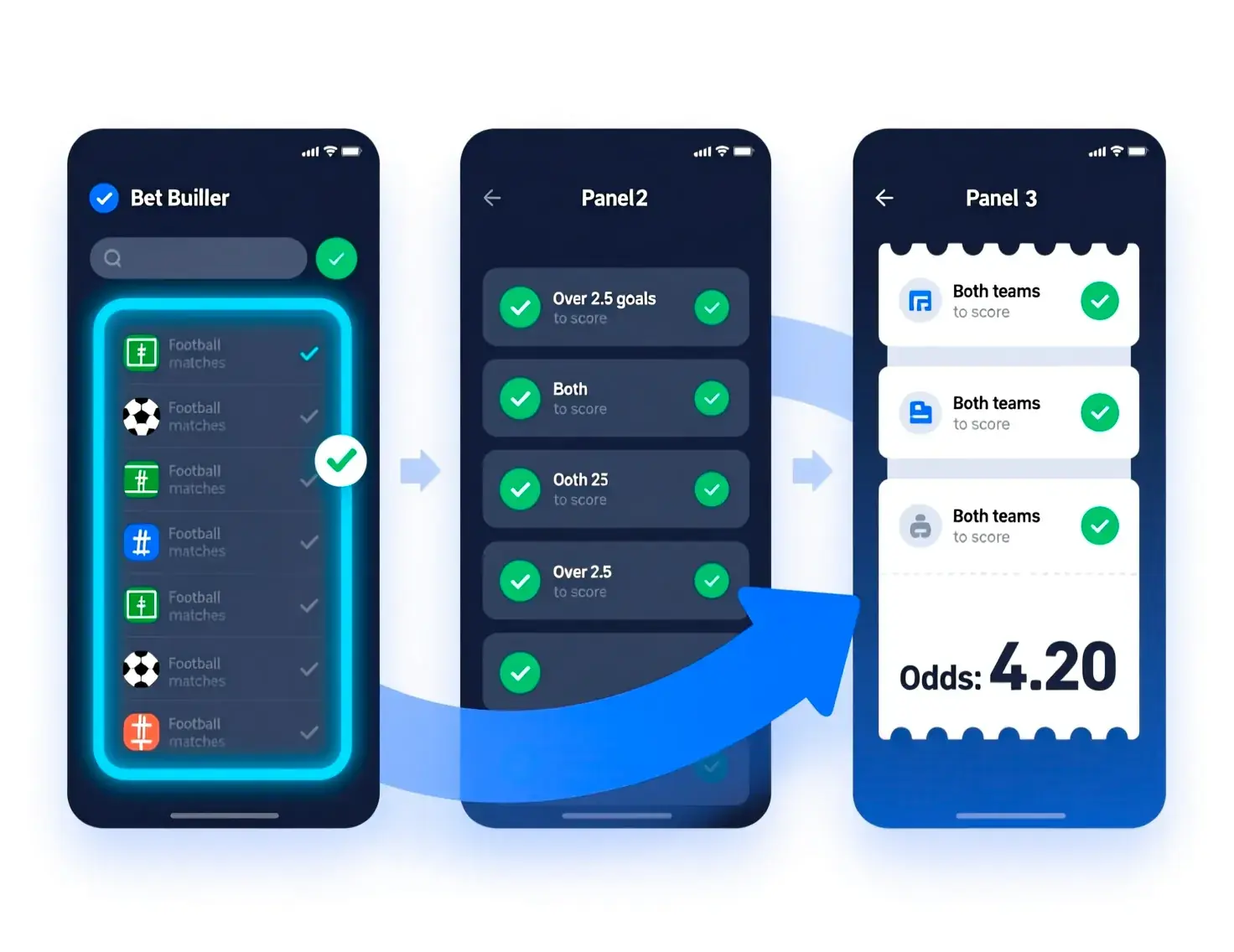
The bet builder process: Select match → Choose multiple options → Get combined odds
The real innovation here isn't just convenience. It's the handling of what the industry calls "related contingencies." Before bet builders existed, bookmakers wouldn't let you combine certain outcomes from the same match in an accumulator because they're correlated. If Manchester City is thrashing someone 5-0, the probability of Kevin De Bruyne getting an assist obviously increases. These outcomes aren't independent, and traditional betting structures couldn't price that correlation properly. Bet builders solved this problem with sophisticated pricing algorithms that adjust odds based on how selections interact with each other.
Most platforms let you stack anywhere from two to twelve selections, though some go even higher. Betfair, for instance, allows up to 25 selections in a single bet builder, which is frankly excessive for most situations, but the option exists. The sweet spot tends to be three to five selections where you're balancing enhanced odds against realistic probability. Go beyond that and you're essentially buying a lottery ticket with slightly better odds.
Historical Context
The history behind build bet is actually quite interesting. It started with social media requests. Punters would tweet at bookmakers asking for odds on wild combinations like "Liverpool to win, Salah to score twice, and over 11 corners." Someone at the betting companies realized they were fielding thousands of these requests and thought, why not automate the entire process? The hashtag #YourOdds became William Hill's thing, #RequestABet popped up elsewhere, and eventually, every major bookmaker built dedicated tools that let bettors construct these wagers themselves. What began as a customer service solution evolved into one of the most profitable products in sports betting.
Build Bet vs Accumulator: Critical Differences
This comparison matters more than most bettors realize, and getting it wrong costs people money every weekend. On the surface, both bet types involve combining multiple selections for enhanced odds. That's where the similarity ends.
An accumulator—or acca, as it's commonly called—strings together selections from different events. You might back Manchester United to beat Chelsea, Barcelona to defeat Real Madrid, and Bayern Munich to win their match. Three separate games, three independent outcomes. The odds multiply together in straightforward fashion because what happens in Manchester has zero impact on what happens in Bavaria. If United win 1-0 while Bayern are getting battered 3-0 in Munich, those results don't influence each other at all.
Build bet operates within the confines of a single event. Every selection you make relates to the same match, and this creates inherent correlation. If you're building a bet on Liverpool versus Arsenal and you select Liverpool to win plus over 3.5 goals, those outcomes are positively correlated. Liverpool winning decisively makes a high-scoring game more likely. The bookmaker's algorithm recognizes this relationship and adjusts the combined odds downward compared to what you'd get if these were independent events in an accumulator.
The odds calculation difference is substantial. In an accumulator, if you back three teams at 2.00, 3.00, and 1.50, your combined odds are simply 2.00 × 3.00 × 1.50 = 9.00. Pure multiplication. With a bet builder, the math gets complicated because the bookmaker is modeling correlation. Your three selections might individually price at 2.00, 3.00, and 1.50, but combined in a bet builder, you might only get 6.50 because the outcomes aren't independent. The stronger the positive correlation between your selections, the more the odds get compressed.
Risk profiles differ fundamentally too. Accumulators spread risk across multiple events, which means external factors like refereeing decisions, weather in different locations, and injuries across various matches all contribute to your bet's fate. Build bets concentrate everything into ninety minutes of one match. You're not diversified. You're making a focused bet that requires deep knowledge of specific teams, players, and match dynamics. Some bettors prefer this concentration because they feel their edge is strongest when analyzing a particular fixture they know inside out. Others find the lack of diversification nerve-wracking.
Hybrid Approach
Here's something most people miss: certain bookmakers now let you combine multiple bet builders into an accumulator. Bet365's "Bet Builder+" feature allows exactly this. You can build a bet on the Manchester derby, another on Liverpool's match, and combine both into one mega-wager. This hybrid approach gives you the customization of bet builders with the diversification of an accumulator, though obviously the risk multiplies accordingly. If either match doesn't play out as you've structured it, the entire thing collapses.
The void rules vary significantly too. With a standard accumulator, if one leg voids because a match gets postponed, most bookmakers will settle your bet as a smaller accumulator minus that leg. Your 5-fold becomes a 4-fold. Build bet policies differ by platform. Bet365 and Betfair typically let the bet continue with remaining selections at adjusted odds if one market voids. Other bookmakers might void your entire bet builder if a single player you've selected doesn't start the match. This isn't a small detail. It's the difference between your bet surviving or dying before kick-off.
How to Place a Build Bet: Step-by-Step Process
The mechanics vary slightly between platforms, but the fundamental process remains consistent. Let's walk through this assuming you've already got an account with a bookmaker and you've deposited funds. If you haven't, that's your first step—pick a licensed operator, verify your identity, and load some money. Don't skip the responsible gambling limits setup. Future you will appreciate having guardrails in place.
Start by navigating to the sport you want to bet on. Football is overwhelmingly the most popular choice for bet builders because the market depth is unmatched. Premier League, Champions League, and major European leagues all get comprehensive bet builder coverage. Click through to the specific match you're interested in. You'll typically see the bet builder option prominently displayed, usually as a tab near the top of the match page labeled "Bet Builder," "BuildABet," or something similar depending on your bookmaker.
Once you're in the bet builder interface, you'll see the available markets organized into categories. Match result options, goal markets, player performance statistics, team statistics like corners and cards. The selection is honestly overwhelming at first. Don't try to use every market. Focus on the ones you've actually researched or have genuine insight about.
Make your first selection by clicking the odds. Let's say you're confident Arsenal will beat Nottingham Forest, so you click Arsenal to win. The platform immediately adds this to your bet slip and shows you the current odds. Now you start adding additional selections. Perhaps you believe there will be over 2.5 goals in the match, so you add that. Notice how the odds adjust. They're not simply multiplying Arsenal to win times over 2.5 goals. The bookmaker's algorithm is calculating the correlated probability.
Here's where it gets interesting. As you add more selections, the platform provides real-time feedback. If you try to add contradictory selections—like backing Arsenal to win to nil and also betting on both teams to score—the system won't let you proceed. You'll get an error message explaining that these outcomes are incompatible. This guard rail prevents you from accidentally placing impossible bets, though it can sometimes be frustrating when you're testing different combinations and the platform rejects what you thought was a reasonable pairing.
Keep adding selections until you've built the bet you want. Three selections is a solid starting point. Maybe Arsenal to win, over 2.5 goals, and Martin Ødegaard to have two or more shots on target. The bet slip now shows your three selections, the combined odds, and a stake box. Enter your stake. The platform calculates your potential return automatically. Double-check everything. Seriously, take ten seconds to review each selection because once you've confirmed, there's no undo button.
Hit the confirm button. You'll get a receipt or reference number. Screenshot it if you're the cautious type. Your bet is now live and you can track it through the bookmaker's "My Bets" section. Most platforms offer cash out functionality, which we'll discuss in detail later, allowing you to settle your bet early for a partial return if things are going your way or cut your losses if disaster strikes.
Mobile Experience
The mobile experience mirrors this process but with touch interface considerations. Buttons are bigger, scrolling is more prominent, and some bookmakers offer mobile-exclusive features like push notifications when players in your bet builder are substituted or when markets in your bet are being settled.
One platform-specific note: Sky Bet's BuildABet interface is particularly clean, making it great for beginners. Bet365 offers the most comprehensive market depth. Betfair allows the most selections. Choose based on what matters to you, but honestly, the core process is similar enough that once you've placed a bet builder on one platform, you can figure out any other within minutes.
Best Markets for Building Bets
Not all markets are created equal when it comes to building bets. Some offer genuine value and logical correlation. Others are traps designed to separate optimistic punters from their money. Let's break down what actually works.
Match result markets form the foundation of most successful bet builders. Backing a team to win, especially a favorite at home against relegation-threatened opposition, provides a solid base with reasonable probability. You can then layer additional selections that correlate positively with this outcome. If Manchester City is hosting a struggling side, betting on City to win gives you roughly 70-80% likelihood assuming typical Premier League odds. Building from this foundation makes more sense than starting with a 50-50 proposition like the draw.
Half-time/full-time combinations can offer value but require careful analysis. Betting on Arsenal to be winning at half-time and full-time against Luton makes logical sense. Arsenal typically starts strong, dominates possession, and controls games. Combining this with Arsenal to win is redundant because you're essentially doubling down on the same outcome, but pairing it with something less correlated like total corners offers better odds structure.
Goal markets are the bread and butter of bet builders. Over/under 2.5 goals is the most popular threshold, and for good reason. In a Premier League match between two attacking sides, you can reasonably project a high-scoring affair. Combining this with both teams to score creates positive correlation if you're expecting an open game. Liverpool versus Manchester City, for instance, frequently produces matches where both teams find the net and the total goals exceed 2.5. These aren't independent outcomes, but they're logically consistent.
Exact score betting in a bet builder is brave bordering on reckless unless you've got genuinely strong reasoning. The odds look tempting because correct score bets pay generously, but you're stacking improbability on top of your other selections. If your three-selection bet builder already has roughly 20% combined probability of landing, adding a correct score drops you into single-digit percentage territory. Mathematically, you need the odds to compensate for this probability decrease, and they rarely do sufficiently.
Player performance markets require the most research but can provide the best edges. Betting on a striker to score anytime seems obvious, but dig deeper. Look at expected goals data, shot volume, conversion rates, and matchup specifics. Erling Haaland against a defense that plays a high line and leaves space in behind is a completely different proposition than Haaland against a deep-sitting block that neutralizes his pace. Context matters enormously.
Shots and shots on target markets offer interesting opportunities. Players like Mohamed Salah and Bruno Fernandes consistently register high shot volumes. Betting on two or more shots on target for these players, especially in favorable home fixtures, provides solid probability. Combine this with a team win and you've got positive correlation without being redundant. If Liverpool is winning, Salah is probably involved, which likely means he's taking shots.
The player to be carded market requires understanding both the player's disciplinary record and the referee's tendencies. Some players commit tactical fouls regularly. Some referees hand out cards like party invitations while others let the game flow. Casemiro getting booked in a high-intensity derby isn't exactly a shock. Pair this with a Manchester United win (assuming the card comes when protecting a lead) and you've got a logically structured bet.
Corner markets correlate strongly with possession and attacking intent. Teams that dominate possession and play with width tend to win more corners. Manchester City regularly racks up 8-12 corners in home matches against defensive opponents. Liverpool under Klopp similarly generated high corner counts. Building a bet with City to win and over 9.5 corners creates logical correlation based on game state. If City is winning, they're probably controlling the match, which means corner opportunities.
Statistical Markets Warning
Statistical markets like total tackles, passes, and possession percentages are available on some platforms but honestly, they're harder to predict with accuracy and the odds usually aren't generous enough to justify the research required. Stick with markets where you can develop genuine insight without needing a PhD in data science.
Winning Build Bet Strategies
Strategy separates consistent winners from perpetual losers in sports betting. Luck matters in individual bets, but over hundreds of wagers, skill and discipline determine profitability. Here's what actually works.

Strategic approach: Combine analytical thinking with probability assessment
Start with the three-selection sweet spot. Mathematical probability multiplies against you with each additional selection. Three carefully researched picks gives you odds typically ranging from 4.00 to 8.00, depending on your selections, which provides meaningful upside while maintaining realistic win probability. When you jump to six or seven selections, you're chasing odds of 30.00 or higher, and your win rate plummets accordingly. The psychological appeal of massive potential returns is understandable, but the math doesn't lie.
Build from high-probability foundations. If you're 75% confident Barcelona will beat Granada at home, that's your base. Layer additional selections that correlate positively with Barcelona dominating. Over 1.5 Barcelona goals makes sense. Robert Lewandowski anytime goalscorer fits logically. Granada to receive three or more cards aligns with the game state where they're defending desperately. You're not creating independent bets and hoping they all land. You're constructing a scenario where if your base assumption proves correct, the other pieces naturally follow.
Research trumps everything. Genuinely successful bet builders require work. Check team news 48 hours before kick-off. Has the favorite's best defender picked up an injury? Is the opposing striker returning from a three-match ban? These details shift probabilities significantly. Look at head-to-head statistics, not just overall season form. Some teams historically struggle against certain opponents regardless of current league position. Tottenham under various managers has had Arsenal's number at times even when the Gunners were superior on paper.
Referee analysis is underutilized. Referees have distinct styles. Some average seven cards per match, others three. If you're betting on total cards or a player to be booked, knowing that Michael Oliver is officiating versus someone more lenient changes the calculation. This information is publicly available—sites publish referee statistics freely. Use them.
Correlation analysis separates good from great. Positive correlations reinforce your bet's scenario. Manchester United to win plus Bruno Fernandes to score plus over 9.5 United corners paints a picture of United domination that makes internal sense. Negative correlations work against you. Betting on under 1.5 goals and multiple players to score is contradictory. The platform might not block it because it's technically possible, but you're fighting against basic logic.
Bankroll management cannot be stressed enough. The fundamental rule is never stake more than 1-2% of your total betting bankroll on any single bet builder. If you've got £1,000 set aside for betting, your maximum stake per bet should be £10-20. This feels conservative, especially when you're confident about a particular bet, but it's what keeps you alive through inevitable losing runs. Variance in gambling is brutal. You will experience stretches where everything loses despite solid reasoning. Proper bankroll management ensures these stretches don't wipe you out.
Track everything religiously. Maintain a spreadsheet recording every bet builder you place, including date, match, selections, odds, stake, and result. After 50-100 bets, patterns emerge. You'll discover that certain market types are profitable for you while others consistently lose. Perhaps your player prop selections win 55% of the time but your corner bets lose 60% of the time. This data tells you where your edge actually exists versus where you think it exists, and those are often different things.
Avoid the temptation to chase losses. You've had a bad weekend, dropped £200, and Monday Night Football offers a chance to recover it all with one well-placed bet builder. Don't. This mindset leads to oversized stakes on undersized edges. Stick to your system regardless of recent results. Variance cuts both ways—just as bad runs happen, so do good ones. Trust the process.
Time your bets intelligently. Odds fluctuate based on betting volume and money flow. Placing your bet Friday afternoon before team news drops might get you better odds than waiting until Saturday morning when everyone has digested the starting lineups. Conversely, if there's injury uncertainty, waiting until official team sheets are released prevents the nightmare scenario of building a bet around a player who doesn't even start.
Value Shopping
Learn to value shop between bookmakers. A three-selection bet builder on the same match can price differently across platforms. Bet365 might offer 5.50 while Betfair offers 6.20 for identical selections. That 0.70 difference in odds compounds over time into significant profit differences. If you're serious about betting, maintaining accounts across multiple bookmakers isn't optional, it's necessary for maximizing value.
Understanding Void Rules and Cash Out
The technical rules around voids and cash outs probably seem boring until they cost you money. Then they become fascinating very quickly. Let's demystify both.
Void selection scenarios occur when something happens that makes a market unsettleable. The most common situation is a player not starting the match. You've built a bet with Bukayo Saka to have two shots on target, but he's benched at kick-off. What happens depends entirely on your bookmaker's policy. Bet365 typically continues your bet with the remaining selections at adjusted odds. If your three-selection bet builder priced at 7.00 has one leg void, it might now price at 4.50 based on the two remaining selections. Your bet stays alive.
Other bookmakers take a harsher stance. Some void the entire bet builder if any single market voids. You get your stake back, but you lose the opportunity for profit even if your other selections were winning. This is particularly frustrating in scenarios where the voided market was minor compared to your other selections. You've correctly predicted a 3-0 Liverpool win and over 2.5 goals, but because Trent Alexander-Arnold didn't start and you'd backed him for an assist, your entire bet voids. Maddening.
This is why checking platform-specific void rules before placing your first bet builder is non-negotiable. The information exists in the terms and conditions, usually under betting rules or bet builder specific sections. Five minutes of reading can save you significant frustration and money.
Match postponements typically void all bets regardless of bookmaker. If the fixture doesn't happen, your bet builder dies. Weather-related postponements, COVID outbreaks, or other unforeseen circumstances all trigger this rule. There's no workaround. Your stake returns and that's that.
Cash out functionality offers the ability to settle your bet before the match concludes for a value determined by the bookmaker at that moment. The cash out value fluctuates throughout the match based on how your selections are performing and how much time remains. This feature is simultaneously one of the most useful and most abused tools in modern betting.
Here's how it actually works. You've placed a three-selection bet builder priced at 8.00 with a £10 stake for £80 potential return. Sixty minutes into the match, two of your selections have already landed and the third looks likely. The bookmaker now offers you a cash out of £55. You can take the guaranteed £55 profit or let the bet run hoping for the full £80. Neither choice is objectively correct. It depends on probability assessment and personal risk tolerance.
The mathematics of cash out offers favor the bookmaker by design. They're offering you less than the true probability-weighted value of your bet because they need to protect their downside and build in a profit margin. If your remaining selection has a 75% chance of landing based on current match state, a fair cash out might be £65, but they'll offer £55. The £10 difference is their edge for providing the service.
Strategic cash out timing requires discipline. Cashing out when you're winning by a comfortable margin and there's significant time remaining usually isn't optimal. The match state is favorable, time allows for variance, and you're accepting reduced value. Conversely, if your final selection requires something unlikely in the last five minutes, like a specific player to score when they've barely touched the ball, cash out might be wise.
Partial cash out, offered by some bookmakers, lets you secure some profit while leaving a portion riding. If that £55 cash out offer appears, you might take £30 guaranteed while letting £25 worth of the bet continue for full odds. This middle ground appeals to risk-averse bettors who want to lock in something without abandoning the potential for full return.
The scenarios where cash out isn't available are important too. If one of your selections has already lost, cash out disappears. If markets have closed—say a player you've backed has been substituted and the shots on target market for that player is now settled as a loss—you can't cash out. All markets in your bet builder must still be live and winnable for cash out to function.
Using Cash Out for Damage Control
One underappreciated aspect of cash out is its utility for correcting mistakes. You've placed a bet builder and immediately realized you misread something or made a selection error. If the match hasn't started yet, cash out (if available pre-match) lets you escape with minimal loss rather than watching your mistake play out for ninety minutes. It's damage control.
Build Bet Toolkit
Three tools from this guide: measure the correlation discount in your bet builder, compare void-rule outcomes, and check a cash-out offer against fair value.
The guide's own example: 2.00 × 3.00 × 1.50 multiplies to 9.00 as an accumulator, but a correlated bet builder might only pay 6.50. This shows exactly how much the platform is compressing your odds for that correlation — leave selection 3 at 1.00 if you only have two picks.
Based on the guide's own example: a player does not start, and depending on the platform's policy your bet either continues at reduced odds or gets voided entirely with your stake refunded. Always check this rule before placing a bet builder with a selection that could scratch.
The guide is explicit that cash-out offers sit below the true probability-weighted value of your bet — that gap is the platform's margin for offering the convenience.
This tool applies the framework from this guide for general and educational purposes only — it is not betting advice and does not guarantee results. Always gamble responsibly and within your means. If you need help with problem gambling, visit BeGambleAware.org.
Best Build Bet Platforms Compared
Platform choice matters more than most bettors realize. The difference between a good bookmaker and a great one compounds into meaningful profit differences over time. Here's what you need to know about the major players.
Leading betting platforms compared: Features, limits, and unique selling points
Bet365
Market LeaderSelection Limit: Up to 12
Unique Feature: Bet Builder+ (cross-match combinations)
Odds Rating: 8.5/10
Best For: Overall experience
Bet365 sits atop the bet builder mountain for valid reasons. Their market depth is unmatched. Pretty much any player you can think of has props available. Their Bet Builder+ feature allowing cross-match combinations is genuinely innovative, letting you build a bet on Manchester United's match and combine it with a bet builder on the Liverpool game happening simultaneously. The maximum twelve selections hits the sweet spot between flexibility and sanity. Their "Sub On" feature deserves special mention because it solves a problem that plagued bet builders since inception—if your selected player gets subbed off, your bet doesn't automatically void. If a substitute meets your bet criteria, the bet continues. This is huge for player prop bets.
The Bet365 interface is clean without being simplistic. Mobile app performance is excellent, which matters because honestly, most betting happens on phones now. Their odds are competitive, typically within 0.10-0.20 of market best, which is acceptable given the platform's other advantages. Customer service is responsive. The promotional structure includes regular bet builder boosts on featured matches. If you're only going to use one platform for bet builders, Bet365 is the safe choice.
Betfair
Maximum FlexibilitySelection Limit: Up to 25
Unique Feature: Exchange integration
Odds Rating: 8/10
Best For: Advanced bettors
Betfair takes a different approach with their 25-selection maximum, which is frankly absurd but technically available. Their real strength is the exchange integration. You can back a bet builder on the sportsbook and lay related outcomes on the exchange to reduce risk or guarantee profit through arbitrage opportunities. This requires sophistication to execute properly, but for advanced bettors, it's powerful. Their void policy is bettor-friendly—if one leg voids, your bet continues with remaining selections. The weekly reload promotions often include bet builder specific offers.
Betfair's interface is busier than Bet365's. There's more information on screen simultaneously, which some users love and others find overwhelming. The mobile app is functional but not quite as polished. Odds are generally competitive, sometimes even beating Bet365 on specific markets. The £5 free bet promotion for placing bet builders over a certain threshold provides nice value for regular users.
Unibet
Best OddsSelection Limit: Up to 12
Unique Feature: Industry-leading odds
Odds Rating: 9.5/10
Best For: Value hunters
Unibet has built a reputation as the odds leader. Their bet builder prices consistently rate among the best when compared across platforms for identical selections. If you're an odds-conscious bettor who shops around, Unibet frequently offers 0.20-0.50 better value than competitors. This might not sound significant, but compound it over 100 bets and you're talking meaningful profit difference. The twelve-selection maximum is standard. Their cash out functionality is genuinely best-in-class, offering cash out more frequently and at fairer values than most competitors.
The Unibet interface prioritizes simplicity. It's clean, fast, and intuitive even for beginners. Mobile performance is solid. The promotional structure is less aggressive than Bet365 or Betfair, but the core product—better odds—compensates. Customer service is efficient. For value-focused bettors, Unibet deserves serious consideration.
Sky Bet
UK SpecialistSelection Limit: Up to 10
Unique Feature: Popular BuildABets
Odds Rating: 7/10
Best For: Premier League fans
Sky Bet's BuildABet specifically targets the UK market with heavy Premier League focus. The "Popular BuildABets" feature showing what other customers are betting offers social proof that some users find reassuring and others consider noise. The ten-selection maximum is a bit restrictive compared to competitors. The interface is excellent, particularly on mobile where Sky Bet has invested heavily. Integration with Sky Sports content creates a cohesive experience if you're already in that ecosystem.
Sky Bet's odds are acceptable but rarely the best available. Their strength is user experience and the Super 6 free-to-play game integration which adds entertainment value. For casual bettors who prioritize interface over maximizing every fraction of odds value, Sky Bet delivers.
William Hill
Traditional ReliabilitySelection Limit: Standard
Unique Feature: #YourOdds social feature
Odds Rating: 7.5/10
Best For: Social bettors
William Hill's #YourOdds feature pioneered the social request aspect of bet builders. You can still tweet combinations using their hashtag and they'll price it for you, which is novel but honestly, the in-platform builder is easier. They categorize bet builders by odds ranges (6/1 to 14/1, 15/1 to 49/1, 50/1+) which helps if you're targeting specific payout tiers. The platform is reliable without being exceptional. Odds are middle-of-the-road. Their strength is traditional bookmaker reliability—they've been around forever and they're not going anywhere.
BetVictor
Multi-SportSelection Limit: Standard
Unique Feature: Strong non-football markets
Odds Rating: 8/10
Best For: NBA, NFL, Tennis bettors
BetVictor excels in non-football markets. Their NBA bet builders, NFL combinations, and tennis options are comprehensive when many competitors still heavily skew toward football. The boosted bet builders promotion runs frequently, offering enhanced odds on pre-built combinations for featured matches. Their request-a-bet via Twitter actually gets reasonable response times. The interface is clean. Odds are competitive without leading the market.
Platform Selection Strategy
The platform comparison extends beyond these majors, but these five cover 90% of serious bet builder volume. Choosing between them depends on priorities. Maximum value? Unibet. Best overall platform? Bet365. Most selections? Betfair. Best mobile experience? Sky Bet. Non-football markets? BetVictor. Most bettors benefit from maintaining accounts at 2-3 platforms to shop odds and access platform-specific promotions.
Critical: One critical note about platform selection: licensing matters enormously. Stick with bookmakers licensed by reputable authorities like the UK Gambling Commission, Malta Gaming Authority, or Gibraltar regulators. Unregulated operators might offer better odds but they also might not pay out your winnings. The few percentage points in odds improvement aren't worth the risk of a bookmaker disappearing with your balance.
Common Build Bet Mistakes and How to Avoid Them
Mistakes in bet builders are expensive teachers. Learning from others' errors is considerably cheaper than funding them yourself. Here are the patterns that repeatedly cost bettors money.

Avoid these common pitfalls that cost bettors money every weekend
Selection Overload (The Greed Factor)
Selection overload is the most common trap. The psychology makes sense—more selections mean bigger odds which mean larger potential returns. A three-selection bet at 6.00 doesn't excite the same way an eight-selection bet at 45.00 does. The problem is mathematical. Each additional selection multiplies the probability of failure. If each of your eight selections has 75% individual probability of success, which is actually quite high, your combined probability is 0.75^8 = 10%. You're losing this bet nine times out of ten. Those 45.00 odds need to be 90.00 for you to break even long-term, and they're not because the bookmaker has built in their edge.
The solution is disciplined selection count. Limit yourself to 3-4 selections per bet builder unless you have genuinely exceptional conviction about additional picks. Quality over quantity isn't just a cliché in this context. It's the difference between sustainable betting and slow financial bleeding.
Correlation Blindness
Correlation blindness causes consistent problems. Bettors stack selections without considering how they interact. Betting on under 2.5 goals, neither team to score, and multiple players to be carded in a defensive, low-quality match makes logical sense. Those selections positively correlate with a specific match narrative. Betting on over 3.5 goals while also backing both teams to keep a clean sheet is contradictory nonsense. The platform might accept it because technically both could happen if one team scores 4+ in a bizarre match, but you're fighting against basic probability.
Think through the story your bet builder tells. If all selections can plausibly happen within the same match narrative, you've got positive correlation. If your selections require contradictory match states, you've got a problem.
Research Neglect
Research neglect is perhaps the most expensive mistake. Placing a bet builder ten minutes before kick-off based purely on vibes and recent memory is gambling in the purest sense. You might win occasionally through luck, but long-term you're donating money. Successful bet builders require research. Lineup news, form analysis, head-to-head statistics, referee tendencies, weather conditions, team motivation levels—these inputs materially affect outcomes. Spending 20 minutes researching before placing a £20 bet builder isn't optional if you're serious about winning. It's mandatory.
Emotional Bias (Favorite Team Syndrome)
Emotional bias toward favorite teams is insidious because you're often not aware it's happening. You support Manchester United, United are playing a bottom-half team, and you're convinced they'll dominate. Your bet builder reflects this conviction with United to win, multiple United players to score, and United-heavy statistical selections. The problem is your judgment is compromised by emotional attachment. United might genuinely be favorites, but you're overstating their dominance probability because you want them to dominate, not because cold analysis suggests they will.
The solution is uncomfortable but effective: never bet on matches involving your favorite team, or if you do, create the bet builder first and then ask yourself if you'd make the same selections if you had no emotional attachment. Be honest. If the answer is no, don't place the bet.
Chasing Losses (The Death Spiral)
Chasing losses destroys more betting bankrolls than any other single factor. You've lost £100 over the weekend. There's a Monday night match. You calculate that a bet builder at 10.00 odds with £15 stake would win you £150, recovering your losses plus profit. This reasoning is fatally flawed. Past results have no bearing on future bet probability. The match doesn't know or care that you're down £100. Your selections don't become more likely to land because you need them to. Increasing stakes when losing is the exact opposite of sound bankroll management. It's how recreational bettors become problem gamblers.
Stick to your predetermined stake sizes regardless of recent results. Losing streaks happen to everyone, even professional bettors. They're variance, not judgment of your abilities. Trust your system and accept that short-term results fluctuate wildly around long-term expectation.
Void Rule Ignorance
Void rule ignorance has already been mentioned but bears repeating because it's such a common stumbling block. You've built a beautiful six-selection bet, researched thoroughly, got good odds, and then one player doesn't start. On one platform, your bet continues. On another, it voids entirely. Not knowing which platform operates which way beforehand leaves you vulnerable to unpleasant surprises. Read the rules. It takes five minutes and prevents future frustration.
FAQ

What makes bet builders different from regular accumulators?
Bet builders combine selections from a single match while accumulators span multiple matches. The critical difference is that bet builders allow "related contingencies" that traditional accumulators prohibit. You can bet on Liverpool to win and Mo Salah to score in the same match because the bet builder algorithm prices the correlation between these outcomes. An accumulator requires each selection to come from different events where outcomes are independent. The odds calculation differs fundamentally—accumulators simply multiply odds together, while bet builders adjust for correlation, usually resulting in lower combined odds than you'd expect from straight multiplication.
Can I cash out my bet builder before the match finishes?
Yes, most major bookmakers offer cash out on bet builders, but availability depends on specific conditions. All markets in your bet must still be live and winnable. If one selection has already lost, cash out disappears immediately. If a player you've backed has been substituted and his individual market is now settled, that affects cash out availability. The cash out value fluctuates throughout the match based on how your selections are performing and remaining time. The amount offered will be less than your potential full return because bookmakers build in a margin, but it allows you to guarantee profit or minimize losses before final settlement.
How many selections should I include for the best chance of winning?
Three to five selections represents the optimal balance between enhanced odds and realistic winning probability. With three selections averaging 70% individual probability, your combined success rate is roughly 34%, which is manageable. Pushing to eight or more selections drastically reduces your win rate even with high-probability picks—eight selections at 70% each gives you only 5.7% combined probability. The odds increase substantially with more selections, but not proportionally enough to compensate for the probability decrease. Most successful bet builders stay in the three to four selection range where you're balancing meaningful odds enhancement against realistic chance of all selections landing.
